While You Were Watching the Epstein Files: Congress Moved to Kill the Internet (And Let Predators Walk Free)

On the same day the DOJ released heavily-redacted Epstein files, both chambers of Congress introduced legislation that could destroy the internet as we know it—all while claiming to protect children. The irony is as dark as it gets.
The Perfect Storm of Misdirection
December 19, 2025 will be remembered for two simultaneous events that reveal everything wrong with how power operates in America. While the nation's attention fixated on the Department of Justice's partial (and heavily-redacted) release of Jeffrey Epstein files, Congress quietly introduced bipartisan legislation to sunset Section 230 of the Communications Decency Act—the legal foundation that enabled the internet to exist.
 My Privacy Blog
The timing wasn't coincidental. It was strategic.
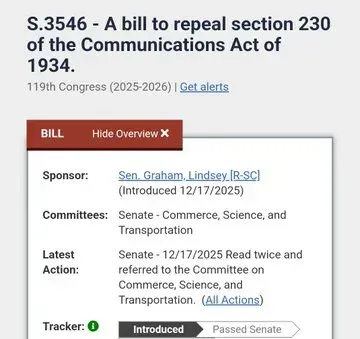
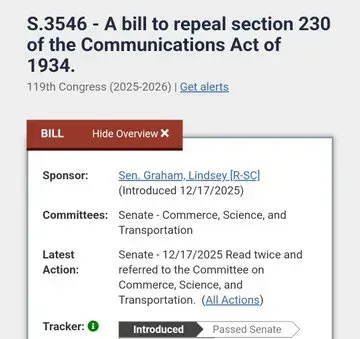
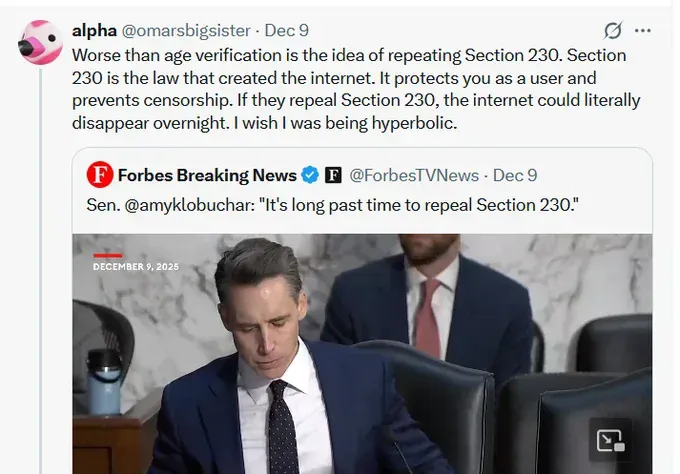
In the Senate: Lindsey Graham (R-SC) and Dick Durbin (D-IL) introduced the "Sunset Section 230 Act" (S.3546), which would completely repeal Section 230 on January 1, 2027 unless Congress enacts a replacement framework. The bill passed through the Senate Commerce Committee with bipartisan support from Josh Hawley (R-MO), Amy Klobuchar (D-MN), Marsha Blackburn (R-TN), Richard Blumenthal (D-CT), and others.
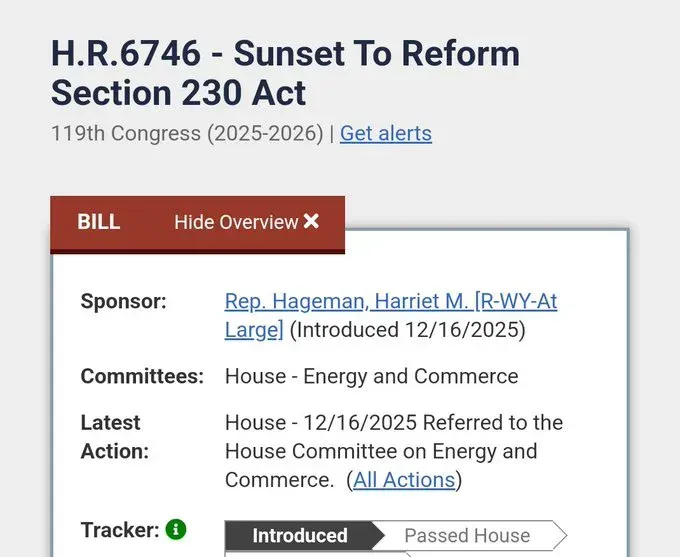
In the House: Rep. Harriet Hageman (R-WY) introduced H.R. 6746, the companion "Sunset To Reform Section 230 Act," which was referred to the House Energy and Commerce Committee on December 16, 2025.
Both bills claim the same justification: protecting children from online exploitation. But experts warn the actual effect would be catastrophic—not just for the internet, but for the very prosecution of child predators these lawmakers claim to be fighting.
What Section 230 Actually Does (And Why Repealing It Helps Criminals)
Section 230 of the Communications Decency Act contains twenty-six words that created the modern internet:
"No provider or user of an interactive computer service shall be treated as the publisher or speaker of any information provided by another information content provider."
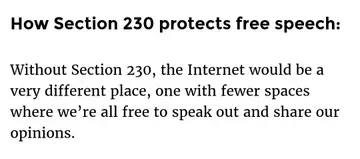
This simple provision allows platforms to host user-generated content without becoming legally liable for everything users post. Without it, every blog comment, forum post, social media update, and online review would expose the hosting platform to potential lawsuits.
But here's where the lie becomes obvious: Section 230 has never protected platforms from federal criminal law. Section 230(e) explicitly states that its protections do not apply to federal criminal statutes, including those related to child sexual exploitation (18 U.S.C. §§ 2252, 2252A, 2258A).
Platforms are already required by federal law to:
- Report known child sexual abuse material (CSAM) to the National Center for Missing & Exploited Children
- Remove CSAM when discovered
- Preserve evidence for law enforcement
They report tens of millions of cases annually. The system works because it's voluntary, which means searches conducted by platforms aren't considered "state action" under the Fourth Amendment.
Here's the fatal flaw in repealing Section 230: If you remove immunity protections and threaten platforms with state-level criminal prosecution unless they proactively scan all user content, you transform them into government agents. Under established Fourth Amendment jurisprudence, that makes evidence they collect inadmissible in court.
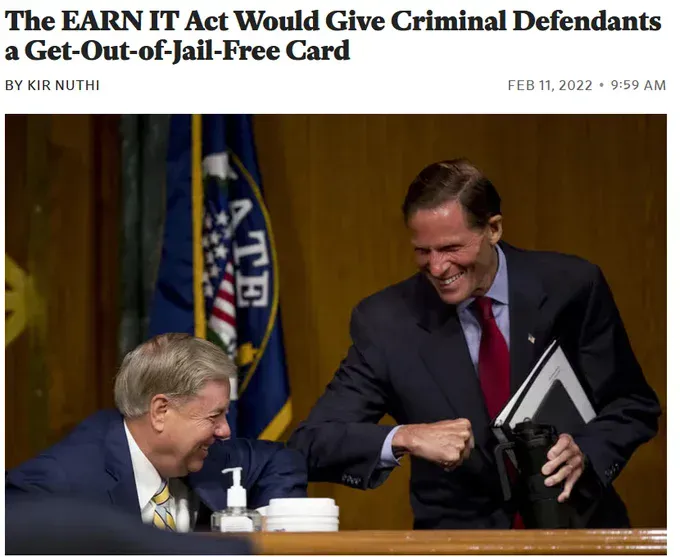
As legal experts warned about the similar EARN IT Act: this would give child predators a "get-out-of-jail-free card."
Let me repeat that because it's critical: Repealing Section 230 in the name of protecting children would actually make it harder to convict child predators.
Either senators like Graham, Durbin, Hawley, and Klobuchar don't understand basic constitutional law, or they're lying about their intentions.
Manufacturing Consent Through Grieving Parents
The most cynical aspect of this legislative push is how lawmakers have weaponized the pain of families who lost children to online harms. Organizations like Less Than 3, Enough Is Enough, Zero Abuse Project, and others have endorsed the Section 230 repeal, believing the promise that removing platform immunity will enable them to sue tech companies.
But these families are being lied to.
What actually happens if Section 230 is repealed:
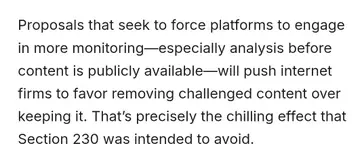
- Massive Self-Censorship: Platforms will either moderate nothing (to avoid publisher liability) or moderate everything (to avoid any controversial content). Neither protects children.
- Destruction of Small Platforms: Only massive corporations like Meta and Google can afford the legal teams and automated censorship systems to survive. Independent forums, community sites, and innovative startups disappear.
- Encryption Becomes a Liability: End-to-end encryption—the gold standard for protecting children's privacy—becomes evidence of negligence because platforms can't scan encrypted content. Bye-bye, secure communications.
- Constitutional Crisis: Evidence collected under the threat of state prosecution gets thrown out of criminal trials, letting actual predators walk free.
- Internet Balkanization: Every state can enforce its own criminal standards, creating 50+ different legal regimes that no platform can simultaneously satisfy.
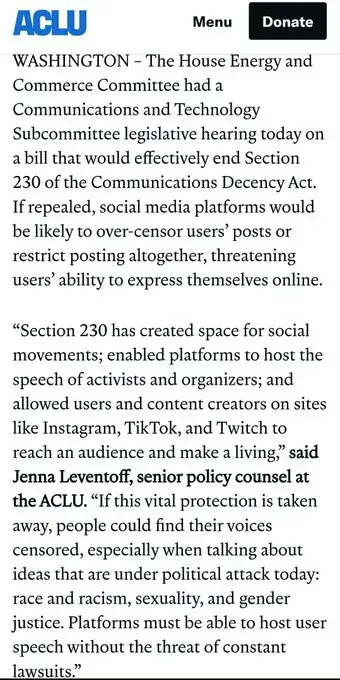
The ACLU put it bluntly: repealing Section 230 "will undermine the privacy of every single American, stifle our ability to communicate freely online, and harm LGBTQ people, sex workers, and protesters."
Civil rights groups understand what Graham and Durbin won't admit: this isn't about child safety. It's about control.
The Epstein Files: A Carefully Orchestrated Distraction?
While Congress moved against the internet, the Department of Justice released what it called the "Epstein files"—except they didn't release all of them, and much of what they did release was either already public or so heavily redacted as to be useless.
The Epstein Files Transparency Act, signed by President Trump on November 19, 2025, required the DOJ to release all unclassified records by December 19, 2025. The law explicitly stated that "no record shall be withheld, delayed, or redacted on the basis of embarrassment, reputational harm, or political sensitivity."
What we got instead:
- Thousands of pages that were already public from previous court cases
- Heavily redacted documents with entire pages blacked out
- Missing names of "at least 20 men accused of sex crimes" according to Rep. Thomas Massie (R-KY)
- Photos of Bill Clinton with Epstein and Ghislaine Maxwell, but no new substantive revelations
- No timeline for when the remaining documents will be released
Deputy Attorney General Todd Blanche promised "several hundred thousand" documents would come later, but provided no enforcement mechanism or deadline.
Senate Minority Leader Chuck Schumer called it "nothing more than a cover up to protect Donald Trump from his ugly past."
Whether or not that's true, the partial release served a perfect function: it dominated news cycles and social media while Congress quietly moved to fundamentally restructure how the internet operates.
And Then Cloudflare Went Down. Again.
In a coincidence almost too perfect, Cloudflare—the infrastructure company that powers roughly 20% of the internet—suffered another outage on December 19, 2025, the same day as the Epstein file release.
This marked Cloudflare's second major outage in less than three weeks (following the November 18, 2025 incident). The pattern is concerning:
- November 18, 2025: Multi-hour global outage affecting X (Twitter), ChatGPT, and major platforms
- December 5, 2025: 25-minute outage affecting LinkedIn, Shopify, Zoom, and government portals (28% of Cloudflare's HTTP traffic)
- December 19, 2025: Another disruption during peak Epstein file release traffic
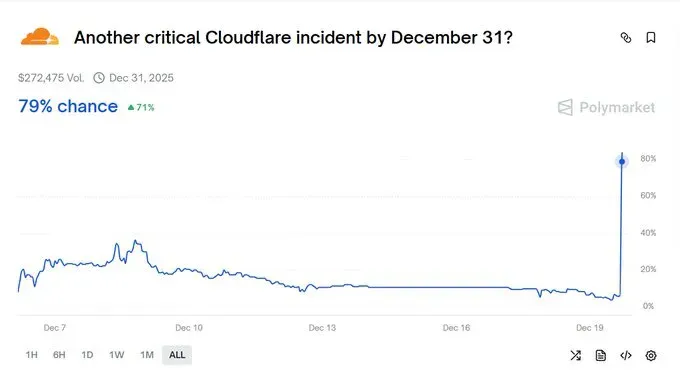
A Polymarket prediction market showed odds spiking to 79% for "Another critical Cloudflare incident by December 31," with traders noting they could monitor the CloudflareStatus.com API to front-run betting markets during outages.
The timing raises questions: When the last major document dump about powerful elites went online (the original Epstein files in previous years), did Cloudflare experience similar disruptions?
As we noted in our previous analysis, "When Cloudflare Sneezes, Half the Internet Catches a Cold"—these outages demonstrate the critical fragility of internet infrastructure concentration. If Section 230 is repealed, expect this problem to get exponentially worse as only the largest providers can afford to operate.
What You're Not Being Told About Internet Regulation
The bipartisan push to gut Section 230 isn't happening in isolation. It's part of a coordinated assault on internet freedom that includes:
KOSA (Kids Online Safety Act): Passed the Senate 91-3 in July 2024, creates vague "duty of care" obligations that would enable state attorneys general to dictate what content platforms can host based on claimed harms to minors. In practice, this means conservative states can target LGBTQ content while progressive states go after gun forums. For a comprehensive breakdown of how KOSA fits into the broader assault on internet freedom, see our complete analysis of the bipartisan attack on digital rights.
SCREEN Act (Screen Time Reduction and Enhanced Enforcement Now Act): Uses "protecting children from screen addiction" as justification for unprecedented data collection requirements and platform monitoring. We've documented how the SCREEN Act serves as a Trojan horse for mass digital surveillance.
EARN IT Act: Would require platforms to "earn" Section 230 immunity by following government-recommended "best practices" for combating CSAM—practices that legal experts warn would gut encryption and Fourth Amendment protections.
Age Verification Mandates: Multiple bills would require age verification for accessing social media or "adult" content, creating a surveillance infrastructure that tracks every American's internet usage.
As documented in the Compliance Officer's Guide to Congressional Internet Regulation, over 20 bills are currently working through Congress that would fundamentally transform how the internet operates—almost all with bipartisan support.
This isn't a left vs. right issue. It's a power vs. people issue.
The Surveillance Infrastructure Connection
The Section 230 repeal doesn't exist in a vacuum—it's part of a decades-long construction of a comprehensive surveillance and control apparatus. The framework connecting the Patriot Act, FISA 702, NDAA provisions, the Espionage Act, and the erosion of net neutrality creates a seamless pipeline from mass data collection to content control.
As we've documented in our analysis of how these surveillance laws interconnect, the pattern is clear: each piece of legislation removes another layer of protection while claiming to address a specific threat. Section 230 repeal is the missing piece that forces platforms to become active surveillance partners rather than passive infrastructure.
The intersection of Section 702, Net Neutrality, the Internet Bill of Rights, and the Patriot Act reveals how government surveillance powers, corporate control of internet access, and the absence of constitutional protections online combine to create a perfect storm for authoritarian control. Adding mandatory content scanning through Section 230 repeal completes the architecture.
The Uniparty Reveals Itself
Rhode Island Senator Sheldon Whitehouse (D), one of the Section 230 repeal co-sponsors, inadvertently revealed the game when he said: "At long last, we are proceeding to file a bipartisan Section 230 repeal. We've been working on that for a long time and I think it's time now to make the decision."
Translation: We've been waiting for the right political moment to push this through when public attention is distracted.
The Electronic Frontier Foundation, one of the internet's most vocal defenders, warns that without Section 230, "the free and open internet as we know it couldn't exist."
MIT professor Sinan Aral outlined the binary choice facing platforms if Section 230 is repealed: "Either platforms will decide they don't want to moderate anything, or platforms will moderate everything."
Given America's litigious culture, platforms will choose the latter. Every controversial opinion, every political critique, every inconvenient fact becomes a potential lawsuit. Small platforms can't afford the risk. Independent voices get silenced. Only corporate-approved speech survives.
This is the point. The goal isn't protecting children. It's ensuring that the only speech that survives is speech that doesn't threaten power.
What Happens Next
The bipartisan nature of this assault makes it particularly dangerous. When both parties agree on restricting civil liberties, the traditional opposition dynamics fail.
Former President Trump signed an executive order targeting Section 230. President Biden opposed the law. Now Congress has overwhelming support to eliminate it entirely.
The sunset provision in the new bills—giving Congress until January 1, 2027 to find a "replacement"—is meant to force tech companies to negotiate. But negotiate what? A system where government commissions decide what content is acceptable? Where encryption is criminalized? Where every online platform operates under 50 different state-level criminal codes?
For those in cybersecurity and privacy advocacy, the implications are stark:
Privacy Dies: No Section 230 means platforms must scan all content. End-to-end encryption becomes impossible. Every message, every photo, every video must be readable by automated systems and potentially by government-mandated auditors.
Small Security Research Communities Disappear: Disclosure forums, vulnerability databases, security tool repositories—all face existential legal risk. Only corporate-controlled platforms survive.
Compliance Costs Skyrocket: As detailed in our Section 230 analysis, the compliance infrastructure required to operate under 50+ different state criminal regimes would be insurmountable for anyone except the largest tech companies.
Innovation Stops: No startup can launch with the legal exposure that comes from hosting any user-generated content. The internet freezes in its current corporate-dominated form.
Evidence Gets Suppressed: Child predators walk free because evidence collected under coercive scanning regimes violates the Fourth Amendment.
The Choice Ahead
We're facing a manufactured crisis. Lawmakers are using the very real harm of child exploitation to justify legislation that would:
- Make it harder to prosecute child predators
- Destroy the open internet
- Enable mass surveillance
- Centralize power in the hands of a few tech giants
- Criminalize encryption and privacy
And they're doing it with bipartisan support while the public is distracted by partial document dumps about dead pedophiles.
The Epstein files matter. The names in those documents matter. The powerful men who exploited children should be exposed and prosecuted.
But if you think repealing Section 230 will accomplish that, you've been lied to.
What it will accomplish is ensuring that the next generation of Epsteins operate in a world where encrypted communications are illegal, where whistleblower platforms don't exist, where investigative forums are liability nightmares, and where the only speech that survives is speech approved by corporate legal departments and government commissions.
The internet that helped expose Epstein—through forums, encrypted communications, persistent investigators, and platforms willing to host uncomfortable truths—is the internet Section 230 created.
Repealing Section 230 won't protect the next victim. It will ensure we never hear about them.
What You Can Do
- Contact your representatives and tell them you oppose Section 230 repeal. Be specific: mention S.3546 and H.R. 6746.
- Support organizations defending internet freedom: Electronic Frontier Foundation, ACLU, Fight for the Future, NetChoice.
- Educate others about what Section 230 actually does and why repealing it helps criminals.
- Demand real transparency on the Epstein files, including a timeline for full release and an explanation for redactions that violate the Transparency Act's explicit language.
- Follow the money: Track which organizations are pushing Section 230 repeal and who funds them.
- Prepare for infrastructure failure: The Cloudflare outages demonstrate how fragile our centralized internet infrastructure has become. If Section 230 is repealed, expect this to get worse.
The surveillance state doesn't arrive with jackboots and tanks. It arrives with a bill to "protect the children" that both parties support and that passes while you're distracted by the latest scandal.
They're counting on you not paying attention until it's too late.
Don't let them win.
Related Coverage:
Internet Freedom & Regulation:
- The Bipartisan Assault on Internet Freedom: How KOSA, Section 230 Repeal, and 20+ Bills Threaten Your Digital Rights
- The SCREEN Act: How Protecting Children Became the Trojan Horse for Mass Digital Surveillance
- Section 230: The Backbone of the Internet and Its Controversies
- The Compliance Officer's Guide to Congressional Internet Regulation
Surveillance Framework Analysis:
- Connections Between the Espionage Act, NDAA, Whistleblower Protection Act, FISA 702, Patriot Act, Net Neutrality and IBOR
- Intersection of Section 702, Net Neutrality, the Internet Bill of Rights, and the Patriot Act
Infrastructure & Third-Party Risk:
Live Tracking: