Federal court delivers decisive blow to government-mandated digital ID requirements, finding they violate First Amendment protections
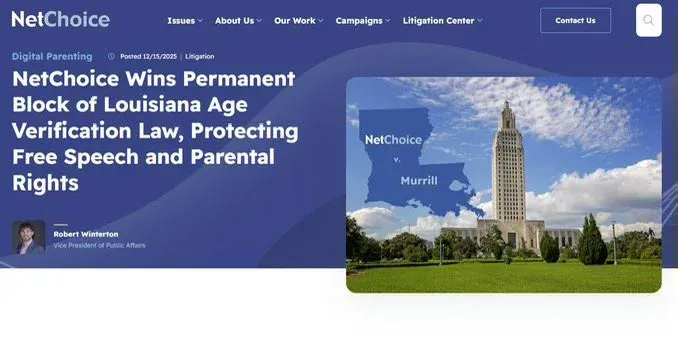
In a landmark ruling that reverberates far beyond Louisiana’s borders, a federal court has permanently blocked the state’s age verification law, declaring it an unconstitutional violation of free speech rights. The December 15, 2025 decision in NetChoice v. Murrill marks the latest—and perhaps most definitive—defeat for the growing wave of state legislation attempting to impose digital identification requirements on internet users.
Google Adds Age Check Tech as Texas, Utah, and Louisiana Enforce Digital ID Laws
The Ruling: A Comprehensive Rejection
U.S. District Judge John W. deGravelles didn’t mince words in his 94-page opinion, granting summary judgment to NetChoice and permanently enjoining enforcement of Louisiana’s Act 456. The court found the law violated the First Amendment on multiple grounds, describing it as simultaneously “wildly underinclusive” and “vastly overinclusive.”
“The government lacks authority to restrict access to lawful speech it does not like,” said Paul Taske, Co-Director of NetChoice’s Litigation Center. “As the district court recognized, the First Amendment forbids the government from posting ID-checks outside the library door—and the same is true when it comes to social media.”
The Louisiana law, which would have required social media platforms to verify users’ ages and obtain parental consent for minors, attempted to condition Louisianans’ access to protected online speech on their willingness to surrender sensitive government identification. Judge deGravelles found this requirement fundamentally incompatible with constitutional protections.
The Constitutional Problems: A Triple Threat
The court identified three fatal flaws in Louisiana’s approach:
1. Content-Based Censorship
The law’s definition of “social media platform” was inherently content-based, triggering strict scrutiny—the highest level of constitutional review. The statute regulated websites that “allow users to interact socially” while exempting sites with other “predominant or exclusive functions” like news, sports, entertainment, or gaming.
As Judge deGravelles noted, this distinction required examining a website’s content to determine coverage—a classic First Amendment violation. The court cited the Supreme Court’s recognition in Packingham v. North Carolina that social media represents “perhaps the most powerful mechanism available to a private citizen to make his or her voice heard.”
2. Simultaneously Over- and Under-Inclusive
The court found Louisiana’s law failed basic tailoring requirements in both directions:
Overinclusive: The law burdened vast amounts of protected speech for both minors and adults. A user would need to verify age and obtain parental consent to access platforms like Facebook—even to view posts by politicians and public officials—but would gain unrestricted access to potentially harmful content once these threshold barriers were cleared.
Underinclusive: Identical speech remained freely accessible on smaller platforms (those with fewer than 5 million users) and websites with exempted functions. As the court observed, “minors will still be able to interact socially on unregulated websites.”
The judge drew parallels to Brown v. Entertainment Merchants Association, where the Supreme Court struck down California’s violent video game law, noting that Louisiana—like California before it—was “perfectly willing to leave this dangerous, mind-altering material in the hands of children so long as one parent says it’s OK.”
3. Unconstitutionally Vague
Perhaps most damningly, the court found the law’s coverage definition so unclear as to be “unconstitutionally vague.” The undefined phrase “predominant or exclusive function” left companies guessing whether they were regulated, creating risks of both over-enforcement (companies blocking legitimate speech to avoid penalties) and arbitrary enforcement by state officials.
The court specifically highlighted platforms like Twitch, which straddle multiple categories, as examples of the law’s unworkable ambiguity: “If enough people use an online videogame for social interaction as opposed to, or in conjunction with, gaming, does the ‘predominant function’ of the videogame change, such that it is suddenly covered by the Act?”
Privacy Nightmares and Practical Problems
Beyond constitutional concerns, Judge deGravelles highlighted the law’s practical failures. The court noted expert testimony that age verification would require “probing users’ sensitive documents” like government IDs and financial records—documents many users, particularly minors, struggle to obtain.
Moreover, the court observed that such requirements would “all but kill anonymous speech online” and create significant privacy risks. As NetChoice has argued throughout similar challenges nationwide, forcing citizens to surrender private information to access the internet is a “gift to hackers and a nightmare for cybersecurity.”
The ruling emphasized that parents already have numerous tools to control their children’s internet access—from device-level controls to platform-specific parental features. “Parents, not the government, are best suited to decide how their families use the internet,” Taske emphasized.
A Pattern of Defeats for Age Verification Laws
Louisiana’s defeat joins a growing catalogue of judicial rejections of similar state laws. This permanent injunction follows NetChoice victories in:
- Ohio (NetChoice v. Yost): Summary judgment granted, law permanently enjoined- Arkansas (NetChoice v. Griffin): Summary judgment granted, law permanently enjoined- Mississippi (NetChoice v. Fitch): Currently on appeal after preliminary injunction granted- Utah, Georgia, Florida, Tennessee, and Texas: All facing successful constitutional challenges
In fact, eight federal district courts have now granted injunctive relief against such laws, with only one declining to do so—and even that court did not rule on the merits.
As Justice Brett Kavanaugh noted in a concurrence when the Supreme Court considered Mississippi’s law, it’s “no surprise” that district courts keep striking down these statutes. He observed that NetChoice has “demonstrated that it is likely to succeed on the merits—namely, that enforcement of the Mississippi law would likely violate its members’ First Amendment rights.”
Implications Beyond American Borders
The Louisiana ruling carries particular resonance for international debates over online regulation. In his analysis, Judge deGravelles essentially established that age verification requirements are structurally incompatible with American constitutional principles—regardless of their stated purpose or target.
This has direct implications for foreign regulatory schemes, particularly the United Kingdom’s Online Safety Act. As critics have noted, the UK’s approach—which includes age verification and content regulation mechanisms—represents a “constitutional fight that you won’t win on U.S. soil.”
The fundamental tension is this: While UK regulations may operate within British constitutional frameworks that lack explicit free speech protections comparable to the First Amendment, American platforms operating globally cannot comply with such requirements without violating U.S. constitutional law when it affects American users.
The Louisiana court’s decision reinforces that American law will not permit age verification barriers to accessing protected speech, creating an irreconcilable conflict for platforms trying to navigate divergent regulatory regimes.
The Government’s Failed Arguments
Louisiana’s defense of its law rested primarily on three claims, all rejected by the court:
1. “This regulates conduct, not speech”: The state argued age verification merely regulated business practices upstream from speech itself. Judge deGravelles dismissed this distinction, noting that preventing access to platforms is tantamount to preventing access to speech. The court analogized it to requiring ID checks before entering a library—obviously a First Amendment issue despite being technically about building access.
2. “Similar laws exist for alcohol and tobacco”: The state pointed to age restrictions on physical products. The court found this comparison inapt, noting that most listed items don’t constitute speech. More importantly, age verification for social media isn’t like checking ID for alcohol in a supermarket—it’s like requiring age verification to enter the supermarket, blocking access to all products inside.
3. “We have a compelling interest in protecting minors”: While the court acknowledged this interest in principle, it found Louisiana failed to demonstrate a causal link between social media use and harm to minors. The court was particularly critical of the state’s expert witness, Dr. Jean Twenge, noting she: (1) couldn’t provide consensus definitions of “social media” or “mental health,” (2) had no formal criteria for including or excluding studies, and (3) relied solely on correlational rather than causal evidence.
What This Means for Policymakers
The Louisiana decision sends an unambiguous message to lawmakers nationwide: good intentions don’t override constitutional rights. Laws that condition access to speech on government-approved identification will be struck down, regardless of their stated purpose.
NetChoice urges legislators to abandon these unconstitutional mandates and instead focus on:
- Educational initiatives to help parents and minors navigate online spaces safely2. Empowering parents with information about existing parental control tools3. Supporting platform innovations in age-appropriate design without government mandates4. Respecting constitutional boundaries rather than forcing prolonged legal battles
As the court emphasized, “parents already have tools by which they can control their children’s access to, and regulate their children’s use of, social media platforms.” The solution to concerns about minors online isn’t government surveillance and speech restrictions—it’s empowering families with knowledge and existing tools.
The Road Ahead
While this decision is a permanent injunction—not merely a preliminary order—Louisiana could potentially appeal to the Fifth Circuit Court of Appeals. However, the comprehensive nature of Judge deGravelles’ opinion and the pattern of similar defeats in other circuits suggest any appeal faces an uphill battle.
More significantly, the decision adds to a growing body of precedent that will likely deter other states from pursuing similar legislation. With courts consistently finding these laws unconstitutional, the legal and political costs of enacting them become increasingly difficult to justify.
NetChoice’s Litigation Center continues to challenge age verification laws across the country, maintaining its role as what advocates call “the unyielding legal sentinels of the Internet, defending the perimeter of the First Amendment from US domestic government censorship.”
Conclusion: Age Verification’s Constitutional Dead End
The Louisiana ruling crystallizes what multiple courts have now recognized: mandatory age verification for accessing lawful online speech is constitutionally prohibited. These laws fail not because courts don’t care about children’s safety, but because they sacrifice fundamental rights in pursuit of a goal that could be achieved through less restrictive means.
As Judge deGravelles concluded: “Ohio’s response to a societal worry that children might be harmed if they are allowed to access adult-only sections cannot be to ban children from the library altogether absent a permission slip.”
The First Amendment means the government cannot demand your papers before you read, speak, or associate with others—whether at a physical library or its digital equivalent. Louisiana’s law, like its counterparts in other states, attempted to do exactly that. Today’s ruling reaffirms that such restrictions, no matter how well-intentioned, remain unconstitutional in America.
For those concerned about minors’ online safety, the path forward is clear: work with parents, platforms, and educators to promote digital literacy and empower families—not to erect government checkpoints at the gates of the internet.
Full case resources for NetChoice v. Murrill are available at netchoice.org/netchoice-v-murrill-louisiana, and the complete court ruling can be read here.