Ireland's Push for Mandatory Social Media ID Verification: The EU's Next Privacy Catastrophe


Analysis: How mandatory identity verification creates a global surveillance honeypot
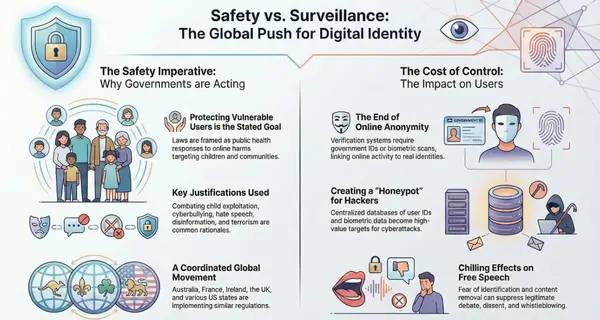
Ireland is preparing to leverage its upcoming EU Council presidency to champion mandatory identity verification across all social media platforms. Tánaiste Simon Harris has announced plans to require users to verify their identities before accessing social networks, effectively ending online anonymity in the name of combating bots, disinformation, and protecting children. While the stated goals sound reasonable, the cybersecurity implications are catastrophic.
The Proposal: Ending Digital Anonymity
Starting July 2026, Ireland will assume the rotating EU Council presidency and has declared online identity verification a central policy objective. The initiative encompasses two main components:
Universal ID Verification: Every social media user across the EU would need to verify their real identity before creating or maintaining accounts. This goes beyond simple email verification to require government-issued ID documentation.
Age Verification System: A parallel effort would create a digital wallet linked to Ireland's existing MyGovID system to verify ages for social media access, modeled after Australia's approach of restricting platforms to users 16 and older.
Harris claims the measure targets "anonymous bots" and "keyboard warriors" spreading disinformation, arguing that anonymity facilitates abuse and undermines democratic discourse. Media Minister Patrick O'Donovan is developing detailed proposals expected within the next four months.
The Irish government anticipates support from French President Emmanuel Macron and UK Prime Minister Keir Starmer, suggesting coordinated European action rather than isolated national measures.
The Orwellian Irony: Banning Pseudonymity to Protect Democracy
The proposal to eliminate anonymous speech in defense of democracy carries a staggering historical irony. Some of history's most important democratic discourse happened under pseudonyms:
- George Orwell (real name Eric Blair) penned "1984" and "Animal Farm" under a pen name
- The Federalist Papers, foundational documents of American democracy, were published pseudonymously
- Mark Twain (Samuel Clemens) used his pseudonym for social commentary
- Voltaire wrote dangerous political satire under an assumed name
Pseudonymity has historically protected dissidents, whistleblowers, activists in authoritarian regimes, and individuals discussing sensitive topics. The EU's proposal would eliminate this protection precisely when global surveillance capabilities have reached unprecedented levels.
Will Ireland ban ghostwriting next? What about artists who use stage names? Authors with pen names? The logical endpoint of mandatory identity verification extends far beyond social media.
The Technical Reality: Building the Ultimate Honeypot
From a cybersecurity perspective, mandatory ID verification creates what security professionals call a "honeypot" — but instead of being an intentional trap for attackers, this becomes an unintentional treasure trove waiting to be exploited.
What Gets Created
Every social media platform would be required to store:
- Government-issued ID documents (passport scans, driver's licenses, national ID cards)
- Biometric data (selfies for facial recognition, potentially fingerprints)
- Comprehensive behavioral profiles (every post, like, comment, search, and click)
- Real-world identity mappings (linking anonymous usernames to verified identities)
- Social network graphs (who you communicate with, when, and how often)
- Location data (IP addresses, GPS coordinates, movement patterns)
This creates a centralized, high-resolution map of human behavior linked to verified identities. It's a surveillance state's dream database — and a catastrophic security vulnerability.
When (Not If) The Breach Happens
The question isn't whether these databases will be compromised. The question is how many times and how badly.
Data breach history provides overwhelming evidence:
Recent Massive Breaches:
- X/Twitter (2025): 200 million user records leaked, including names, emails, and profile data
- 16 Billion Password Breach (2024): The largest credential leak in history, spanning 30 databases
- National Public Data (2024): 2.9 billion records including Social Security numbers sold for $3.5 million
- Facebook (2019-2021): 533 million user records from 106 countries exposed
- LinkedIn (2021): 700 million users (90% of their user base) scraped and sold
- Sina Weibo (2020): 538 million Chinese social media users exposed for $250
- India's Aadhaar (2019): 1.1 billion government ID records compromised
These breaches happened without mandatory government ID linking. Add verified identity documentation to the mix, and the damage potential increases exponentially.
The Cascading Consequences
When an ID-verified social media database leaks, the consequences cascade:
Immediate Threats
Identity Theft at Scale: Criminals gain verified government IDs linked to behavioral profiles, enabling sophisticated impersonation attacks.
Targeted Phishing: Attackers can craft personalized phishing campaigns using detailed knowledge of targets' interests, social connections, and communication patterns.
Financial Fraud: Linking verified identities to social networks enables attackers to open credit accounts, file fraudulent tax returns, and access banking systems.
Account Takeover: With real names, government IDs, and associated email addresses, attackers can systematically compromise accounts across platforms.
Long-Term Damage
Permanent Doxxing: Once your verified identity is linked to your anonymous social history, that connection exists forever. Old posts, controversial opinions, and sensitive discussions become permanently attributed to your legal identity.
Political Persecution: Dissidents, activists, and political opponents become trivially identifiable. This isn't theoretical — authoritarian regimes actively exploit such data. Even democracies like Russia's implementation of state-linked digital IDs show how these systems enable comprehensive surveillance.
Social Engineering Attacks: The combination of verified identity and behavioral data enables AI-powered social engineering at unprecedented scale.
Blackmail and Extortion: Access to comprehensive social histories linked to verified identities creates massive blackmail potential.
Cross-Platform Correlation: Leaked databases from multiple platforms can be merged, creating a comprehensive surveillance profile of individuals' entire online existence.
The Child Safety Facade
Proponents justify these measures as protecting children from online harm. The argument deserves scrutiny.
Age verification systems don't require comprehensive identity verification. Cryptographic age attestation systems can prove someone is over a certain age without revealing their complete identity or creating centralized databases.
Technologies like zero-knowledge proofs and privacy-preserving attestation already exist. They can verify age without storing sensitive personal data or creating surveillance infrastructure.
The Irish proposal goes far beyond age verification — it requires comprehensive identity documentation for all users, creating security vulnerabilities that actively endanger the children it purports to protect. As we've seen with Reddit's digital ID enforcement, these systems normalize mass surveillance while doing little to actually protect children.
When (not if) these databases leak, minors' identity documents, behavioral data, and social connections become available to criminals. The very children the policy aims to protect become victims of massive identity theft.
The Bot Problem Doesn't Require ID Verification
The stated justification — combating bots and disinformation — doesn't require mandatory identity verification either.
Effective bot detection uses:
- Behavioral analysis (posting patterns, engagement metrics)
- Device fingerprinting
- Rate limiting and CAPTCHA systems
- Machine learning classification
- Network analysis of suspicious coordination
These technical measures work without compromising privacy or creating honeypot databases. Major platforms already employ sophisticated bot detection that doesn't require government ID verification.
The bot problem is a technical challenge, not a reason to build surveillance infrastructure.
Technical Infrastructure Requirements
Implementing this proposal would require social media platforms to:
- Build ID verification systems capable of processing millions of documents daily
- Store government-issued identification in compliance with data protection regulations
- Implement biometric systems for matching selfies to ID documents
- Create audit trails tracking who accessed verification data and when
- Establish retention policies for sensitive identity documents
- Build backup and disaster recovery systems for identity databases
- Implement breach detection and response capabilities
Each of these components represents a security vulnerability. Each integration point creates attack surface. Each backup creates another target.
The more copies of sensitive data that exist, the more likely compromise becomes.
The Platform Resistance
Major technology companies headquartered in Ireland — including Meta, Google, and X — will likely resist these regulations. Not because they care about user privacy (their business models depend on data collection), but because:
Liability Exposure: Storing government IDs creates massive legal liability when breaches occur. Recent GDPR enforcement trends show regulators imposing record fines — Meta faced €1.3 billion for data transfer violations, while TikTok received €530 million for similar issues in 2025.
Implementation Costs: Building and maintaining verification infrastructure is expensive User Attrition: Mandatory ID verification reduces platform adoption and engagement Competitive Disadvantage: Platforms operating outside EU jurisdiction gain market advantage
Ireland's unique position as host to many tech headquarters creates tension. The country benefits economically from tech company presence while simultaneously proposing regulations those companies oppose.
The Transatlantic Conflict
The proposal occurs amid escalating tensions over digital governance. The U.S. State Department recently sanctioned European officials involved in social media content regulation, including former EU Commissioner Thierry Breton.
Secretary of State Marco Rubio stated: "For far too long, ideologues in Europe have led organized efforts to coerce American platforms to punish American viewpoints they oppose. The Trump Administration will no longer tolerate these egregious acts of extraterritorial censorship."
Mandatory ID verification intensifies this conflict. American companies would be required to collect and store data on American citizens to comply with EU regulations, creating jurisdictional and diplomatic tensions.
The EU's Digital Services Act already requires platforms to self-censor "hate speech" and "disinformation" or face fines up to 6% of global revenue. Adding mandatory identity verification escalates regulatory pressure significantly.
Civil Liberties Organizations Push Back
Digital rights groups have quickly identified the proposal's dangers. The Irish Council for Civil Liberties (ICCL) and Digital Rights Ireland (DRI) raised concerns about privacy, online anonymity, and security.
Dr. TJ McIntyre, chair of Digital Rights Ireland, noted that linking social media to MyGovID would give platforms "even more information about individuals than they have already" and enable tracking of "every web page access" back to specific Irish citizens.
Most social media platforms already use tracking cookies and embedded scripts connecting to advertising networks. Linking these systems to government identity databases creates comprehensive surveillance infrastructure tracking citizens' entire online activity.
Under GDPR's stringent breach notification requirements, platforms would face 48-hour reporting windows for healthcare-related data breaches, with fines up to €20 million or 4% of global revenue for violations. The regulatory burden of securing government ID databases adds massive compliance risk.
The Enforcement Challenge
How would this system actually work in practice?
For EU Citizens: Presumably straightforward — verify identity using government-issued ID and MyGovID wallet system.
For Non-EU Citizens: Would international users be blocked from EU social media access? Would they need to provide foreign government IDs to Irish authorities? How would verification work across different national ID systems?
For VPNs and Proxies: How would enforcement work when users mask their location? Would VPN services be banned? IP-based geoblocking is trivially circumvented.
For Existing Accounts: Would hundreds of millions of existing accounts need retroactive verification? What happens to accounts that don't verify? Mass deletion?
The proposal faces massive practical implementation challenges beyond the security implications.
Alternatives That Don't Create Honeypots
If the genuine goal is protecting children and combating bots without creating surveillance infrastructure, alternatives exist:
Privacy-Preserving Age Verification: Zero-knowledge proofs and privacy-preserving digital identity systems can verify age without revealing identity or creating centralized databases.
Platform-Side Technical Measures: Enhanced bot detection using behavioral analysis, device fingerprinting, and machine learning.
Distributed Verification: Allow trusted third parties to attest to age/identity without platforms storing sensitive data.
User Education: Teach critical thinking and digital literacy rather than building surveillance systems.
Stronger Data Protection: Enforce existing privacy regulations rather than creating new data collection requirements.
These approaches address stated concerns without the catastrophic security implications of mandatory identity databases.
The Precedent This Sets
If Ireland succeeds in implementing mandatory ID verification, it establishes a precedent other nations will follow.
Authoritarian regimes already monitor social media extensively. Mandatory identity verification provides a blueprint for comprehensive surveillance legitimized by democratic nations' example.
"If the EU requires ID verification for online speech, why shouldn't we?" becomes a convenient justification for surveillance states.
The erosion of digital anonymity doesn't stop at social media. Once identity verification becomes normalized for Facebook and X, the logic extends:
- Forums and discussion boards
- Comment sections on news sites
- Messaging applications
- Email services
- Any online communication platform
The endpoint is a fully de-anonymized internet where every keystroke is traceable to a verified identity.
Conclusion: A Security Disaster Waiting to Happen
Ireland's proposal to mandate social media identity verification creates a cybersecurity catastrophe dressed as child protection.
The historical record is unambiguous: Large databases of personal information get compromised. The more sensitive the data, the more valuable to criminals, and the more catastrophic the breach. As recent global privacy enforcement trends demonstrate, regulators imposed over €800 million in fines during Q2 2025 alone — and those were for breaches involving far less sensitive data than comprehensive government ID verification systems would require.
Mandatory ID verification doesn't just create one vulnerable database — it creates dozens. Every social media platform becomes responsible for securing government IDs, biometric data, and comprehensive behavioral profiles. When these inevitable breaches occur, the consequences will be unprecedented.
This isn't about protecting children or fighting bots. It's about building surveillance infrastructure that fundamentally alters the relationship between citizens and digital platforms, eliminates pseudonymous speech, and creates security vulnerabilities that will haunt us for decades.
Eric Blair understood something important when he chose to write "1984" as George Orwell. Sometimes the most important voices need protection from those who claim to protect us.
Ireland assumes the EU Council presidency in July 2026. The cybersecurity community will be watching closely — and building contingency plans for when these databases inevitably leak.