Federal Judge Blocks Texas App Store Age Verification Law: First Amendment Wins Over Digital ID Mandate

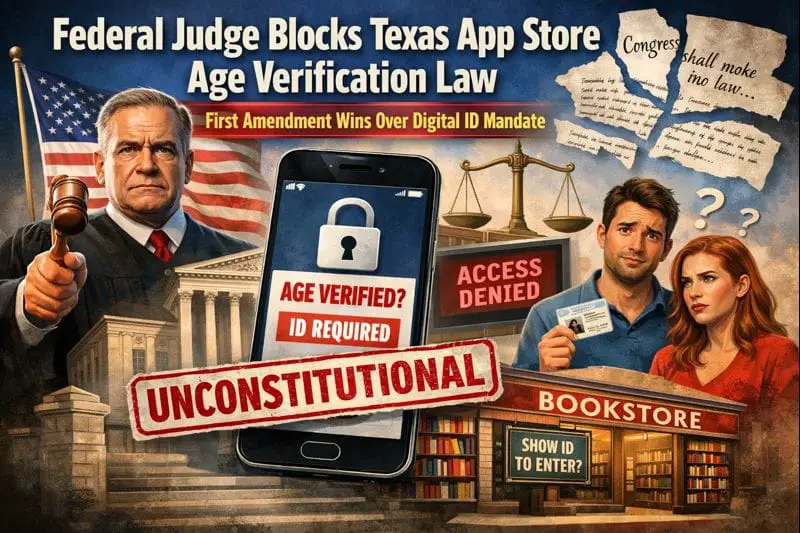
A federal judge has halted Texas's sweeping age verification law just days before implementation, calling it "more likely than not unconstitutional" and comparing it to requiring bookstores to ID every customer at the door.
Executive Summary
U.S. District Judge Robert Pitman issued a preliminary injunction on December 23, 2025, blocking enforcement of Texas Senate Bill 2420—the App Store Accountability Act—which would have required age verification for every app download starting January 1, 2026. The ruling represents a significant victory for digital privacy advocates and marks a critical moment in the escalating battle between state legislatures pushing age verification mandates and federal courts defending First Amendment protections.
The decision affects not just Apple and Google's app stores, but fundamentally challenges the growing trend of age verification laws that threaten online privacy across the United States.
 Compliance Hub
The Law That Almost Was
Texas SB 2420 would have fundamentally transformed how Texans access mobile applications. Unlike narrower age verification laws targeting adult content, this legislation cast an unprecedented wide net:
Universal Age Verification: Every user creating an account with an app store would need to verify their age using government-issued ID or other commercially reasonable methods—whether downloading a weather app, sports tracker, or Bible study application.
Mandatory Parental Controls: Minors under 18 would require their accounts to be linked to a verified parent or guardian account, with individual parental approval needed for each app download and in-app purchase.
Developer Rating Requirements: App developers would be forced to assign age ratings to their applications and provide detailed explanations for those ratings, with liability for "knowingly misrepresenting" content—a standard the court found unconstitutionally vague.
Data Sharing Mandates: App stores would need to share users' age verification data with millions of individual app developers, creating what Google warned were "real privacy and safety risks."
As the comprehensive compliance analysis revealed, the law would have required Apple and Google to fundamentally restructure their platforms and forced developers to implement complex age-gating systems across their entire app catalogs.
The Constitutional Collision
Judge Pitman's 20-page ruling applied strict scrutiny—the most demanding level of constitutional review—because the law regulates speech based on content rather than neutral conduct. Under this standard, Texas needed to prove both a compelling government interest and that the law used the least restrictive means possible.
The court found Texas failed on multiple fronts.
Overbreadth Beyond Reason
The judge's most damning comparison came early in the opinion: "The Act is akin to a law that would require every bookstore to verify the age of every customer at the door and, for minors, require parental consent before the child or teen could enter and again when they try to purchase a book."
This wasn't hyperbole. The law would restrict minors' access to applications including:
- News apps like the Associated Press
- Fitness trackers like Strava
- Educational resources and dictionary applications
- Public library e-book platforms
- Mental health and wellness tools
The court noted that while Texas might have a compelling interest in restricting access to genuinely harmful content, it demonstrated no such interest in blocking minors from "benign apps promoting physical or mental health, news, and entertainment."
 Compliance Hub
Unconstitutional Vagueness
Beyond being overbroad, key provisions of SB 2420 failed to provide clear guidance on compliance. The law exposed developers to liability for "knowingly misrepresenting" an app's age rating but provided no meaningful standards for how those ratings should be determined.
Similarly, requirements for renewed parental consent after "material changes" to apps offered no definition of what constitutes such a change. As the court observed, this vagueness would incentivize over-censorship, as developers might fear liability for routine updates, new content additions, or minor design changes.
This mirrors concerns raised about other age verification systems—the lack of clear standards creates compliance nightmares while chilling legitimate expression.
Comparing Apples and Adult Content
Notably, Judge Pitman distinguished SB 2420 from the Supreme Court's recent decision upholding Texas's narrower age verification law for pornography websites in Free Speech Coalition v. Paxton. That law targeted unprotected obscene content specifically harmful to minors.
In contrast, SB 2420 swept in vast categories of protected speech with no demonstrated connection to harm. The court emphasized that requiring age verification for every app—including weather trackers and sports score applications—was not narrowly tailored to any legitimate state interest.
The Privacy Implications
While Judge Pitman's ruling focused primarily on First Amendment concerns, the privacy stakes underlying this case cannot be overstated. As detailed in previous analysis, SB 2420 created a fundamental tension: a law ostensibly protecting minors simultaneously mandated collection of highly sensitive data from all users.
Apple had warned that the Texas mandate would compromise user privacy by requiring collection of "sensitive, personally identifiable information that isn't currently gathered" for even basic app downloads. Google raised concerns about sharing this verification data with millions of individual developers, noting the "potential for bad actors to sell the data or use it for other nefarious purposes."
These warnings weren't theoretical. Recent data breaches affecting age verification systems have exposed exactly these vulnerabilities—from Discord's breach exposing 70,000 user IDs to broader concerns about third-party verification services.
The law's data sharing requirements were particularly troubling. Under SB 2420, app stores would need to provide developers with access to users' age category information and parental consent status. While the law prohibited retention of this data for purposes beyond verification, enforcement of such restrictions remains uncertain—especially across millions of individual developers.
The Legal Battleground
The preliminary injunction came in response to two consolidated lawsuits challenging the law:
Tech Industry Challenge
The Computer & Communications Industry Association (CCIA), representing over 1.6 million tech sector workers including Apple and Google, filed suit on October 16, 2025. CCIA director Stephanie Joyce celebrated the ruling: "This Order stops the Texas App Store Accountability Act from taking effect in order to preserve the First Amendment rights of app stores, app developers, parents, and younger internet users."
Student Advocacy Coalition
Students Engaged in Advancing Texas (SEAT), along with two Texas teens identified only as M.F. and Z.B., brought a separate challenge arguing the law violated their own First Amendment rights.
Adam Sieff, representing the student plaintiffs, captured the stakes: "App stores allow anyone with a smartphone and an internet connection to access the accumulated sum of virtually all recorded human knowledge and expression. Banning students like SEAT's members, M.F., and Z.B., from accessing these massive libraries without parental consent, just because the government thinks that's what their parents ought to want, has never been constitutional."
Judge Pitman's ruling specifically rejected Texas's argument that the law empowered rather than constrained parental rights. The court pressed this point during oral arguments: "Don't parents already have the control already?" Parents can already buy phones, pay for mobile plans, and restrict children's access through existing tools.
Texas AG Paxton's Expected Response
Texas Attorney General Ken Paxton—who has built a reputation for aggressive tech enforcement with multi-billion dollar settlements against Google and Meta—is expected to appeal the preliminary injunction to the U.S. Court of Appeals for the Fifth Circuit.
In earlier filings, Paxton argued that SB 2420 would survive strict scrutiny because "any restriction on app downloads would be made by a parent or guardian," not the state. He further contended that Texas voters' approval of a "parental rights" amendment to the state constitution supported the law.
The AG's office emphasized that far from taking away parental decision-making, "S.B. 2420 maximizes it by requiring app stores to provide parents with information about apps that children may wish to download."
However, Judge Pitman's ruling suggests these arguments fundamentally misunderstand the constitutional issues. The state cannot accomplish indirectly through regulating intermediaries what it cannot do directly under the First Amendment—and the breadth of SB 2420's restrictions on protected speech distinguishes it from narrower laws the courts have upheld.
Apple Responds: Pause and Monitor
Following the court's decision, Apple announced it would "pause previously announced plans" for Texas-specific app store changes while continuing to monitor the "ongoing legal process."
The company had been preparing significant platform modifications to comply with SB 2420, including:
- New developer tools and APIs for age assurance processes
- Parental consent flow implementations
- Age verification collection systems for account creation
Apple stated these developer tools would remain available for testing and use, but the company will not implement the broader mandatory changes while litigation continues.
This measured response reflects the compliance burden these laws impose even when ultimately blocked. Apple had invested substantial engineering resources preparing for January 1, 2026 compliance—resources that may prove wasted if the law is permanently enjoined.
The Broader Age Verification Landscape
Texas SB 2420 doesn't exist in isolation. The ruling comes amid an escalating wave of state-level age verification mandates creating what one analyst called "an impossible maze" for platforms operating nationally.
The State-Level Patchwork
As of late 2025, 24 states have enacted age verification laws, with approaches varying dramatically:
Adult Content Focus: Most states have followed the model upheld in Free Speech Coalition, requiring age verification specifically for pornography sites. These narrower laws have generally survived constitutional challenge.
Social Media Restrictions: Several states including Texas have attempted broader social media age verification through legislation like House Bill 18 (the SCOPE Act). Federal courts have issued preliminary injunctions against portions of that law as well, signaling judicial skepticism toward expansive age-gating requirements.
App Store Mandates: Texas's SB 2420 represented the most aggressive expansion yet—moving beyond websites and social media to encompass the entire app ecosystem. Louisiana and Utah have pursued similar approaches, creating complex compliance requirements for developers.
International Context
The United States isn't alone in pursuing age verification mandates. The UK's Online Safety Act, which took effect July 25, 2025, requires platforms to use "highly effective age assurance" to prevent children from accessing pornography or content related to self-harm and eating disorders.
Meanwhile, Australia has implemented a social media ban for users under 16, with mandatory age verification for search engines starting December 27, 2025.
These international frameworks demonstrate both the global scope of age verification debates and the varying constitutional constraints different legal systems face. The UK and Australia lack equivalents to the U.S. First Amendment, giving their governments greater latitude to mandate digital identity verification.
What This Means for Compliance Teams
For organizations navigating this evolving regulatory landscape, Judge Pitman's ruling provides important guidance while underscoring continuing uncertainty:
Key Takeaways
Constitutional Scrutiny Matters: Not all age verification laws are created equal. Courts will distinguish between narrowly tailored laws targeting unprotected content (pornography) and overbroad mandates sweeping in vast categories of protected speech.
Vagueness Kills Laws: Compliance requirements must provide clear standards. Laws that create liability without defining key terms or providing safe harbors for good-faith compliance will face constitutional challenge.
Privacy Cannot Be Ignored: While First Amendment arguments dominated this ruling, the privacy implications of mandatory age verification—particularly data collection, retention, and sharing requirements—remain critical concerns that will influence future cases.
State-by-State Complexity: The preliminary injunction blocks SB 2420 specifically. Other state laws remain in effect, creating the compliance patchwork that platforms must navigate. Organizations need jurisdictional compliance strategies that account for varying legal standards.
Practical Next Steps
Organizations subject to age verification mandates should:
- Monitor the Texas Appeal: Judge Pitman's preliminary injunction is not a final ruling. The Fifth Circuit's treatment of this case will provide important precedent for similar laws nationwide.
- Assess Other State Requirements: Review compliance obligations in Louisiana, Utah, and other jurisdictions with active age verification laws.
- Prioritize Privacy-Preserving Technologies: Whether implementing age verification voluntarily or under legal mandate, minimize data collection and retention. Consider privacy-preserving age estimation over document verification where feasible.
- Document Constitutional Concerns: Maintain records of how overbroad or vague requirements burden your platform and users. This documentation could prove valuable in future litigation or regulatory engagement.
- Engage in Policy Discussions: Industry associations and coalitions have successfully challenged these laws. Consider joining collective efforts to shape more balanced legislation.
The Parental Rights Paradox
One of the most interesting tensions in this case involves competing visions of parental authority. Texas framed SB 2420 as empowering parents to protect their children online. Judge Pitman questioned whether the law actually served that goal—or whether it substituted the state's judgment for parental discretion.
Parents can already restrict their children's device usage through:
- Built-in parental control features on iOS and Android
- Family sharing account structures
- App store rating and restriction settings
- Screen time management tools
- Content filtering options
These tools exist precisely because Apple, Google, and other platforms recognized parental demand for digital safety controls. They allow parents to calibrate restrictions based on their individual children's maturity, needs, and circumstances.
SB 2420 would have replaced this flexible, parent-controlled approach with a one-size-fits-all state mandate. Every parent would need to approve every app download for every minor—whether downloading a Bible app, educational resource, or entertainment platform.
This creates particular burdens for families where parents work multiple jobs, have limited digital literacy, or where parent-child relationships are strained. It also raises questions about teens approaching 18 who have demonstrated responsibility but remain legally minors.
Judge Pitman's skepticism of Texas's "parental empowerment" framing reflects broader concerns about government paternalism disguised as family values legislation. The state cannot compel parents to exercise authority in state-approved ways and call that freedom.
What Happens Next
The preliminary injunction blocks SB 2420's January 1, 2026 effective date, but several legal steps remain:
Immediate Effect: Attorney General Paxton is enjoined from enforcing the law while the case proceeds. Apple and Google can maintain their current age verification approaches in Texas.
Expected Appeal: Paxton will almost certainly appeal to the Fifth Circuit Court of Appeals, which has jurisdiction over Texas federal cases. The appeals court could affirm Judge Pitman's reasoning, reverse the preliminary injunction, or modify its scope.
Supreme Court Possibility: Given the nationwide implications and conflict with other circuits' treatment of age verification laws, this case could eventually reach the U.S. Supreme Court—particularly if Texas prevails at the Fifth Circuit level.
Facial Invalidation Analysis: Judge Pitman indicated the court would next consider whether SB 2420 is facially invalid—meaning unconstitutional in all or nearly all applications. A finding of facial invalidity would permanently enjoin the entire law, rather than just specific provisions.
Legislative Response: Texas lawmakers could attempt to amend the law to address constitutional concerns, though the breadth of Judge Pitman's critique suggests wholesale revision would be necessary.
The Digital Identity Creep
While this ruling represents an important victory for digital rights, the broader trend toward mandatory online identity verification continues largely unchecked. As documented extensively, age verification serves as a gateway to comprehensive digital ID systems.
The pattern is now familiar:
- Frame the requirement as "protecting children"
- Implement age verification for specific content categories
- Expand gradually to cover more platforms and services
- Normalize identity verification as prerequisite for online participation
- Eventually mandate digital ID for all internet users
Texas SB 2420 would have accelerated this progression dramatically—moving from adult content to the entire app ecosystem in a single legislative stroke. Judge Pitman's intervention slows but doesn't stop this trajectory.
Other states continue pursuing similar mandates. International jurisdictions like the UK and Australia have already implemented broad age verification requirements with minimal judicial resistance. And federal legislation remains possible, particularly as child safety concerns unite lawmakers across partisan divides.
The infrastructure being built—age verification APIs, identity databases, third-party verification services—will outlast any individual law. Technical systems like Google's Play Signals API create persistent tracking capabilities that extend far beyond their ostensible age-gating purposes.
The Free Speech Stakes
At its core, this case involves fundamental questions about who controls access to information in a digital age:
Can states require identity verification as a condition of accessing lawful content?
Can governments force platforms to restrict minors' access to protected speech based on paternalistic determinations of appropriateness?
Can intermediaries like app stores be compelled to serve as gatekeepers and data collectors on behalf of state regulatory schemes?
Judge Pitman answered these questions clearly: when restrictions sweep so broadly as to encompass vast categories of protected speech with no demonstrated connection to harm, they violate the First Amendment regardless of the state's benevolent intentions.
The ruling reinforces core principles that have shaped internet law for decades:
- Content-based speech restrictions face the highest level of judicial scrutiny
- Overbroad regulations that sweep in protected speech alongside potentially harmful content cannot survive constitutional review
- Vague standards that create compliance uncertainty and chill lawful expression are unconstitutional
- The government cannot accomplish through intermediary regulation what it cannot do directly
These principles matter because they prevent the normalization of digital surveillance and control. Once identity verification becomes standard for app downloads, the technological and social barriers to expanding such requirements drop precipitously.
Conclusion: A Temporary Victory
Judge Pitman's preliminary injunction represents an important milestone in the fight to preserve online privacy and free expression. By blocking Texas's unprecedented app store age verification mandate, the court reaffirmed that constitutional protections apply in digital spaces and that child protection cannot serve as carte blanche for sweeping surveillance requirements.
However, this is not a final victory. The case will continue through appeals, potentially reaching the Supreme Court. Other states continue enacting similar laws. And the global momentum toward age verification and digital identity requirements shows no signs of slowing.
For compliance professionals, the landscape remains complex and rapidly evolving. Organizations must navigate a patchwork of state requirements while monitoring ongoing litigation. Texas alone maintains multiple privacy enforcement mechanisms—from the Texas Data Privacy and Security Act to biometric identifier protections to industry-specific regulations.
For privacy advocates, the work continues. Every victory in court must be matched by policy advocacy, public education, and technical innovation to preserve digital rights. The infrastructure of surveillance being constructed—whether through age verification, AI monitoring, or other mechanisms—poses long-term threats that transcend any individual statute.
And for internet users, the stakes could not be higher. The pseudonymous internet that enabled free inquiry, vulnerable expression, and digital exploration for decades faces existential challenges. Whether accessing news, connecting with communities, or simply downloading apps to check the weather—increasingly these basic activities require proving who you are to government-approved gatekeepers.
Judge Pitman's ruling preserves space for the internet we've known. Whether that space can be defended in the long term remains an open question.
Related Resources:
- The Global Age Verification Disaster: How Privacy Dies in the Name of "Safety"
- Texas SB2420: Complete Compliance Guide for App Stores and Developers
- Texas App Store Age Verification Law Faces Legal Challenges: What Compliance Teams Need to Know
- Google Adds Age Check Tech as Texas, Utah, and Louisiana Enforce Digital ID Laws
This article represents analysis current as of December 25, 2025. Legal and regulatory developments continue to evolve rapidly in this space.