Congressional Resolutions Challenge EU and UK Online Censorship Laws' Influence on US Free Speech

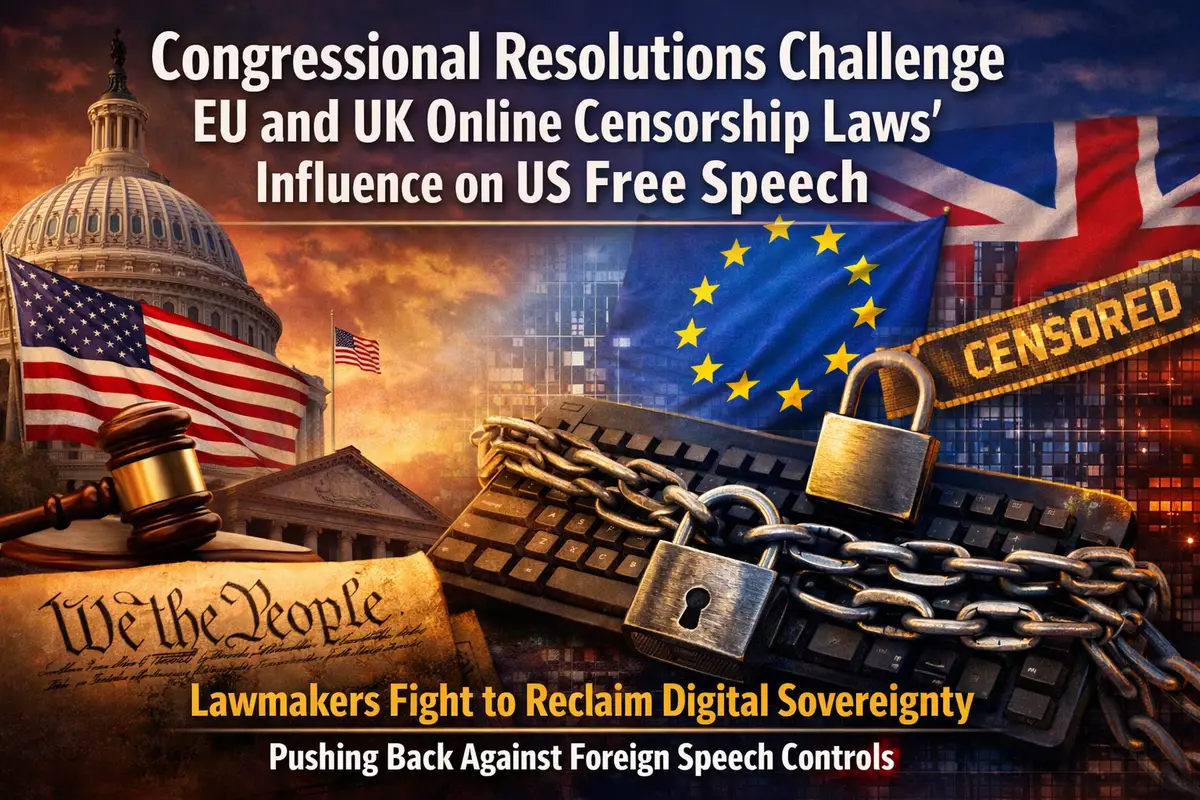
Lawmakers move to reclaim digital sovereignty as Washington confronts the global reach of European speech controls
Two new resolutions introduced in Congress directly challenge the growing influence of European and British online censorship laws on American speech. Together, they signal a coordinated effort to push back against what sponsors characterize as a creeping erosion of First Amendment freedoms by foreign regulatory regimes.
Related Reading: For comprehensive background on how these regulatory frameworks operate, see our detailed analysis: The EU's Digital Services Act: A New Era of Online Regulation.
Senate Takes Aim at the EU's Digital Services Act
In the Senate, Senator Mike Lee (R-UT) introduced S. Res. 567 on December 18, 2025, declaring that "any attempt by foreign entities to censor or penalize constitutionally protected speech of United States persons shall be opposed." Senator Ted Cruz (R-TX) has joined as a cosponsor.
The resolution frames freedom of expression as a defining principle of American identity, describing it as "a hallmark of American exceptionalism" and "necessary to ensure that truth can always be spoken, lies can always be exposed, and important questions can always be asked, and that the strong can always be challenged and the vulnerable can always be heard."
The Senate measure specifically condemns the European Union's Digital Services Act (DSA), arguing that the law seeks to export European censorship norms across borders. It warns that the EU has been "attempting to force United States entities to use products and technology to censor and undermine free speech occurring in the United States" and that it "threatens steep penalties under the Digital Services Act if United States entities do not implement the censorship regime required under the Act."
Specific Incidents Cited
Senator Lee's resolution cites two specific incidents as evidence of overreach:
The August 2024 Trump Interview Warning: On August 12, 2024, then-European Commissioner Thierry Breton sent a public letter to Elon Musk ahead of his planned interview with then-candidate Donald Trump on X. The letter warned of potential DSA violations if the conversation amplified "harmful content" that might "spillover" to the EU. The resolution characterizes this as an attempt to influence "the conversation between United States citizens on United States soil."
X CEO Linda Yaccarino responded at the time by calling the letter "an unprecedented attempt to stretch a law intended to apply in Europe to political activities in the US," adding that it "patronizes European citizens, suggesting they are incapable of listening to a conversation and drawing their own conclusions."
For more context on this incident and the broader UK censorship debate, see: Freedom of Speech and Censorship: The Growing Battle in the UK.
The December 2025 Fine Against X: On December 5, 2025, the European Commission announced a €120 million (approximately $140 million) fine against X under the DSA—the first enforcement action of its kind under the law. The Commission cited violations related to X's blue checkmark verification system, which it deemed "deceptive," as well as insufficient advertising transparency and inadequate researcher access to data.
The resolution notes that the DSA authorizes fines of up to 6 percent of a company's global revenue for non-compliance, which could amount to billions of dollars for major American platforms.
Senate Resolution's Demands
S. Res. 567 concludes with seven specific points, including that the Senate:
- Reaffirms its commitment to protecting the commercial interests and free speech rights of United States persons
- Recognizes that the DSA is "incompatible with the free speech tradition of the United States"
- Disapproves of any attempt by a foreign entity to export censorship or levy fines against U.S. persons for constitutionally protected activities
- Disapproves of EU attempts to force U.S. entities to develop or use products and technology that undermine free speech
- Urges the Trump administration to "ensure swift and firm rejoinders to any implementation of disapproved activities"
House Resolution Expands Scope to UK Laws
In the House of Representatives, Representative Jeff Van Drew (R-NJ) introduced H. Res. 967, asserting that "European laws and regulations unfairly and unreasonably burden American speech and innovation."
The House resolution takes a broader approach, targeting not only the EU's Digital Services Act and Digital Markets Act but also the United Kingdom's Online Safety Act and Digital Markets, Competition and Consumers Act—calling for formal U.S. opposition to their enforcement against American companies and citizens.
Warning About Vague Regulatory Terms
The House measure highlights concerns about the political misuse of vague regulatory terminology, warning that "labels like 'misinformation' and 'hate speech' are inevitably used by the powerful to censor critics and silence dissent."
This concern echoes findings from a House Judiciary Committee report released in July 2025, titled "The Foreign Censorship Threat: How the European Union's Digital Services Act Compels Global Censorship and Infringes on American Free Speech." The committee obtained documents through subpoenas showing that, according to the report, European Commission regulators labeled the phrase "we need to take back our country"—described as "a common, anodyne political statement" in American discourse—as "illegal hate speech" that platforms would be required to censor under DSA requirements.
Deep Dive: For detailed analysis of these findings and their implications for US businesses, see: Global Digital Compliance Crisis: How EU/UK Regulations Are Reshaping US Business Operations and AI Content Moderation.
Domestic Censorship Concerns
H. Res. 967 also references congressional oversight findings regarding domestic censorship practices, stating that "the Biden administration coerced and colluded with social media companies to censor First Amendment-protected discourse related to elections and the COVID-19 pandemic."
This references extensive investigations by the House Judiciary Committee and its Select Subcommittee on the Weaponization of the Federal Government, which documented communications between Biden White House officials and social media companies regarding content moderation. Meta CEO Mark Zuckerberg acknowledged in an August 2024 letter to the committee that "senior officials from the Biden Administration, including the White House, repeatedly pressured" Facebook to censor COVID-19 content, including "humor and satire." Zuckerberg wrote that he believed "the government pressure was wrong" and regretted that his company "was not more outspoken about it."
In September 2025, the committee announced that Google had admitted the Biden administration pressured the company to remove YouTube content that did not violate the platform's policies, and committed to reinstating creators previously banned for political speech violations.
Economic and Constitutional Stakes
The House resolution emphasizes both economic and constitutional dimensions, stating that "European digital censorship laws set de facto international standards for content moderation" and that they "violate the due process rights of American companies to administer fines and penalties that amount to targeted trade barriers against Americans."
The Regulatory Landscape
The EU's Digital Services Act
The DSA, which came into full effect in February 2024, requires large online platforms to take responsibility for addressing illegal content and material deemed harmful, with particular focus on disinformation, hate speech, and election integrity. Platforms face fines of up to 6 percent of global turnover for violations.
The law designates platforms with more than 45 million EU users as "Very Large Online Platforms" (VLOPs), subjecting them to the most stringent requirements. Major American companies including X, Meta's platforms, Google, Amazon, and Apple fall under this designation.
Critics argue the DSA's broad definitions of harmful content create incentives for platforms to over-remove lawful speech rather than risk massive fines—a phenomenon sometimes called "collateral censorship."
The UK's Online Safety Act
The UK's Online Safety Act, which received Royal Assent in October 2023, creates duties for online platforms to protect users from illegal and harmful content. The act applies to any service with "links to the United Kingdom," including services with significant UK users or where UK users are a target market.
The act grants Ofcom, the UK's communications regulator, powers to take enforcement action against companies regardless of where they are based. Platforms failing their duties face fines of up to £18 million or 10 percent of global revenue.
Related Coverage: For a comprehensive look at how the UK Online Safety Act, EU DSA, and payment processor pressure are collectively reshaping the internet, see: The Great Internet Lockdown: How Payment Processors, Government Regulations, and Activist Groups Are Reshaping the Digital Landscape.
A September 2025 House Judiciary Committee hearing featured testimony from Nigel Farage, leader of the UK's Reform party, who warned that the UK's approach "treats speech as inherently harmful—akin to tobacco or other dangerous substances."
Digital Markets Regulations
Both the EU's Digital Markets Act (DMA) and the UK's Digital Markets, Competition and Consumers Act (DMCCA), which came into force January 1, 2025, impose additional regulations on large technology platforms, including requirements around interoperability, data portability, and business practices.
Critics argue these laws disproportionately target American technology companies. The DMCCA empowers the UK's Competition and Markets Authority to designate firms with "strategic market status" and impose tailored conduct requirements, with penalties reaching 10 percent of global turnover for violations.
Compliance Alert: For organizations navigating these cross-border requirements, see: Digital Compliance Alert: UK Online Safety Act and EU Digital Services Act Cross-Border Impact Analysis.
Administration Response
The Trump administration has signaled strong alignment with congressional concerns about European digital regulations.
Following the December 2025 fine against X, Secretary of State Marco Rubio posted that "The European Commission's $140 million fine isn't just an attack on @X, it's an attack on all American tech platforms and the American people by foreign governments. The days of censoring Americans online are over."
Vice President JD Vance, who characterized EU content moderation policies as "authoritarian censorship" during his Munich Security Conference speech in February 2025, posted ahead of the fine's announcement that "The EU should be supporting free speech not attacking American companies over garbage."
The administration has also linked digital regulations to broader trade negotiations. Commerce Secretary Howard Lutnick reportedly stated in December 2025 that the EU must revise its digital regulations to secure a deal reducing steel and aluminum tariffs.
Perspectives on the Debate
Supporters of Congressional Action
Proponents of the resolutions argue that foreign speech regulations pose an existential threat to American free expression principles.
Representative Van Drew stated at a September 2025 hearing: "We should be protecting our citizens. Instead, we're watching foreign bureaucrats come to our country and try to force United States companies to censor humor, satire and news they don't like. It's backwards, it's bizarre, it's perverse, and it's weird."
Legal experts who support this view argue that because major platforms typically maintain uniform global content policies, restrictive European laws effectively set worldwide speech standards—allowing foreign bureaucrats to determine what Americans can say online.
Lorcán Price, a barrister and legal counsel for Alliance Defending Freedom International who testified before Congress in September 2025, warned: "Under the DSA, what happens in Europe won't stay in Europe. The internet is global. If American policymakers don't push back against the DSA model, the same speech restrictions now emerging in Europe will be imported here."
Critics of the Resolutions
Democrats and some outside observers have criticized the congressional focus on European laws as misplaced.
Representative Jamie Raskin (D-MD), Ranking Member of the House Judiciary Committee, called the September 2025 hearing on European laws "a drive-by hit against a strong democratic ally to benefit a Donald Trump sycophant." Democrats have argued Republicans should instead focus on what they characterize as domestic threats to free expression under the Trump administration.
The European Commission has rejected characterizations of the DSA as censorship. A spokesperson stated that the December 2025 fine against X addressed transparency violations—specifically the misleading blue checkmark system and advertising repository failures—rather than speech content. The Commission denied any connection between the enforcement action and trade negotiations.
European officials have defended the DSA as necessary to protect users from scams, disinformation, and manipulation, arguing that its transparency requirements actually enhance democratic discourse rather than suppressing it.
Looking Ahead
Both resolutions represent non-binding expressions of congressional sentiment rather than legally enforceable measures. However, they signal potential future legislative or executive action to counter foreign regulatory influence.
The resolutions call on the Trump administration to respond through diplomatic and economic channels, suggesting trade measures could be deployed to counter what sponsors view as extraterritorial censorship regimes.
The outcome of this transatlantic dispute over speech regulation will likely shape the future of global internet governance—determining whether platforms will be able to maintain uniform free expression standards worldwide or will face an increasingly fragmented regulatory environment that critics fear will default to the most restrictive requirements.
For American companies operating globally and citizens communicating across borders, the stakes extend beyond abstract legal principles to everyday questions of what can and cannot be said online.
Sources: Official Senate and House records; House Judiciary Committee reports and hearings; European Commission press releases; contemporaneous media coverage from Reuters, AP, NPR, CNBC, CBS News, Axios, Euronews, and other outlets.