Australia's Teen Social Media Ban Isn't What You Think: 5 Surprising Truths
Introduction: The Experiment Begins
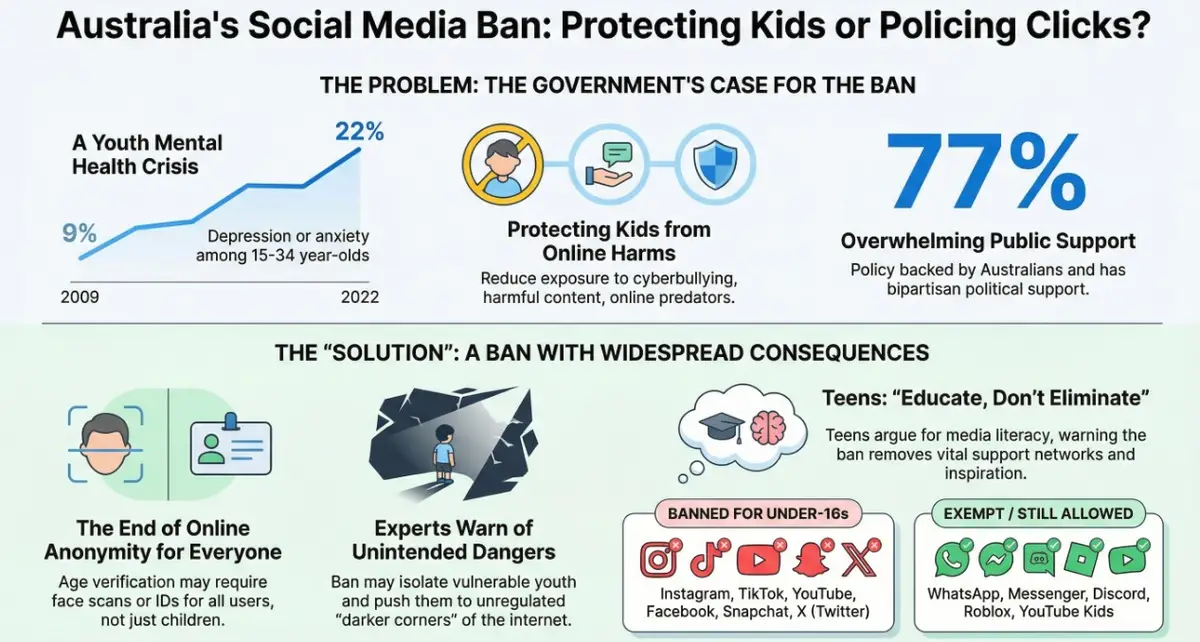
Australia is on the verge of launching a "world-first" social media ban for teens under 16, a move that has captured global attention. But while the headlines focus on protecting kids from the harms of being chronically online, the real story is far bigger, more complex, and has profound implications for every single Australian. This isn't just about restricting screen time; it's a massive social experiment whose true impact will be felt in unexpected ways, reshaping the digital rights of the entire population.
 Compliance Hub
Takeaway 1: It's Not Just for Kids Anymore. It's for Everyone.
The most counter-intuitive aspect of this law is that its enforcement will affect the entire Australian population. To prevent users under 16 from holding accounts on platforms like Instagram, TikTok, and YouTube, companies will be required to implement age verification systems for all users.
This goes beyond social media. A separate but related "Australian Digital ID Age Verification" requirement for search engines is set to take effect on December 27, 2025, with a six-month implementation window requiring full compliance by June 27, 2026. This rule compels services like Google and Bing to implement age assurance checks for all logged-in users.
The significance of this cannot be overstated. Over 90% of Australians use Google, and many remain perpetually logged-in to access services like Gmail, Google Maps, and Google Drive. This new requirement will effectively link their verified, real-world identity to their private search history. This transforms the act of being 'logged in' for convenience into a continuous act of identification, fundamentally altering the relationship between the citizen and the search engine.
 Compliance Hub
Takeaway 2: Teenagers Aren't Just Angry—They're Disappointed (and a Little Relieved).
Contrary to a simple narrative of teenage outrage, the views of Australian teens are remarkably nuanced and sophisticated. The response is a complex mix of frustration, relief, and indifference. Sarai Ades, 14, feels the ban unfairly punishes young people instead of regulating platforms or tackling harmful content from adult creators, while 15-year-old Emma Williamson also expressed a "relief" to be off platforms "designed to lure you in and waste your time." Grace Guo, 14, was largely indifferent, noting that "two years is not a long time to wait."
The core critique from these teens is that the government chose a blanket ban over education. They feel they are being denied the tools to navigate the digital world, not protected from it. As Sarai Ades powerfully stated:
Eliminating [access] without doing anything about building our media literacy is the equivalent of the government banning books until we are 16 and expecting us to magically start reading critically.
This reveals a crucial disconnect: the very group the law aims to "protect" feels the solution misses the point entirely. They are asking for skills, not censorship.
 Compliance Hub
Takeaway 3: The Goal Might Not Be Protecting Kids, But Controlling Information.
While the government’s publicly stated goal is to protect youth mental health, political commentators and critics argue that this may mask deeper motivations aimed at societal control. Critics argue this is a multi-pronged strategy aimed not at child safety, but at reasserting establishment control over the digital public square. The key pillars of this argument are:
- Curbing Political Dissent: Critics fear the state is attempting to control the narrative by cutting off youth access to information about the climate crisis, the genocide in Gaza, and the return of fascism. The ban is seen as a way to prevent the "further politicisation of an entire generation" that is increasingly opposed to the major political parties.
- Expanding State Surveillance: The required age-verification infrastructure creates a system for identifying every user, effectively ending online anonymity. This could allow state agencies, police, and intelligence services to access identification data to target political dissidents and activists.
- Protecting Old Media: Some commentators argue the ban is a strategy to protect traditional corporate media monopolies, such as those owned by Murdoch and Stokes. By cutting off the alternative digital channels preferred by younger generations, the policy could force audiences back to established media gatekeepers.
From this viewpoint, the law is less about protecting children and more about preserving existing power structures by controlling the flow of information. This ambition to control information flow is underpinned by a technical architecture that has profound consequences for every citizen's privacy.
 Compliance Hub
Takeaway 4: You Must Trust Companies Fined Billions for Privacy Violations With Your ID.
The law presents a fundamental paradox: to comply, Australians must hand over sensitive data—like government ID details or biometrics from a "video selfie"—to the very tech companies the legislation is meant to regulate. This is particularly concerning given these companies' poor track records on privacy.
- Google, for example, has faced billions in fines and settlements for major privacy violations. These include tracking users' location data even after they opted out and misleading users about the privacy of "Incognito" mode.
- In one historic case, Google paid a $1.375 billion settlement in Texas for secretly tracking people's movements and collecting biometric data like facial geometry and voiceprints without informed consent.
Cybersecurity experts express deep skepticism about corporate promises to delete this data after verification. They point to past incidents, like the massive Optus data leak where customer information that should have been deleted was retained, as proof that such promises cannot be fully trusted.
 Compliance Hub
Takeaway 5: The Ban Might Drive Kids into Even Darker Corners of the Internet.
A critical question is whether the ban will even work as intended. Both experts and teenagers predict widespread circumvention using tools like VPNs, fake birthdays, or accounts belonging to older family members.
The most significant unintended consequence, however, is the risk of pushing teens away from regulated mainstream platforms and into "less savoury corners of the internet – shady apps, private browsers or unsafe websites." TikTok warned that the ban could see young people "pushed to darker corners of the internet where no community guidelines, safety tools, or protections exist."
This migration could expose them to environments with far fewer safety protections, potentially making them more vulnerable to harm, not less. Instead of eliminating the risks, the ban may simply drive them underground into more dangerous and unmoderated spaces.
 Compliance Hub
Conclusion: A Brave New World or a Cautionary Tale?
Australia's social media ban is a massive social experiment where the state's ambition to control information (Takeaway 3) and the risk of driving kids to darker platforms (Takeaway 5) are being justified by a child safety mandate that the children themselves find misguided (Takeaway 2). This experiment is being built on a foundation of universal age-verification (Takeaway 1) that forces citizens to entrust their most sensitive data to companies with a documented history of violating that trust (Takeaway 4).
While born from a genuine desire to protect children, its implementation creates a powerful tension between safety and liberty. The world is watching to see if this bold move becomes a model for digital governance or a cautionary tale about unintended consequences. In our quest to make the digital world safer for children, how much of our own privacy and freedom are we willing to sacrifice?
 Compliance Hub