The global conversation on artificial intelligence regulation has long been dominated by the giants: the market-driven United States, the rights-based European Union, and the state-centric China. Into this landscape steps an ambitious and unexpected player. In December 2025, Vietnam’s National Assembly passed its first-ever comprehensive Law on Artificial Intelligence, signaling its intent to become a major hub in the digital economy.
But a closer look reveals this is no mere imitation. While Vietnam’s new AI law adopts the EU’s risk-based vocabulary, it is a fundamentally different beast—a state-led, innovation-first gambit designed for speed and sovereignty, deliberately sacrificing pre-market certainty for post-market agility. This article analyzes four of the most impactful provisions that reveal Vietnam’s surprisingly distinct playbook.
1. It’s Not an EU Clone: A “Post-Market” Bet on Innovation
While Vietnam’s law borrows the EU AI Act’s risk-based structure, it makes a critical divergence in its core regulatory philosophy. This is a calculated bet on innovation. The Vietnamese approach defaults to a “post-market” assessment mechanism (hậu kiểm), emphasizing ongoing supervision after a product is released. This stands in stark contrast to the EU’s more stringent “pre-market” (tiền kiểm) model, which prioritizes safety and rights but can slow innovation with burdensome upfront compliance.
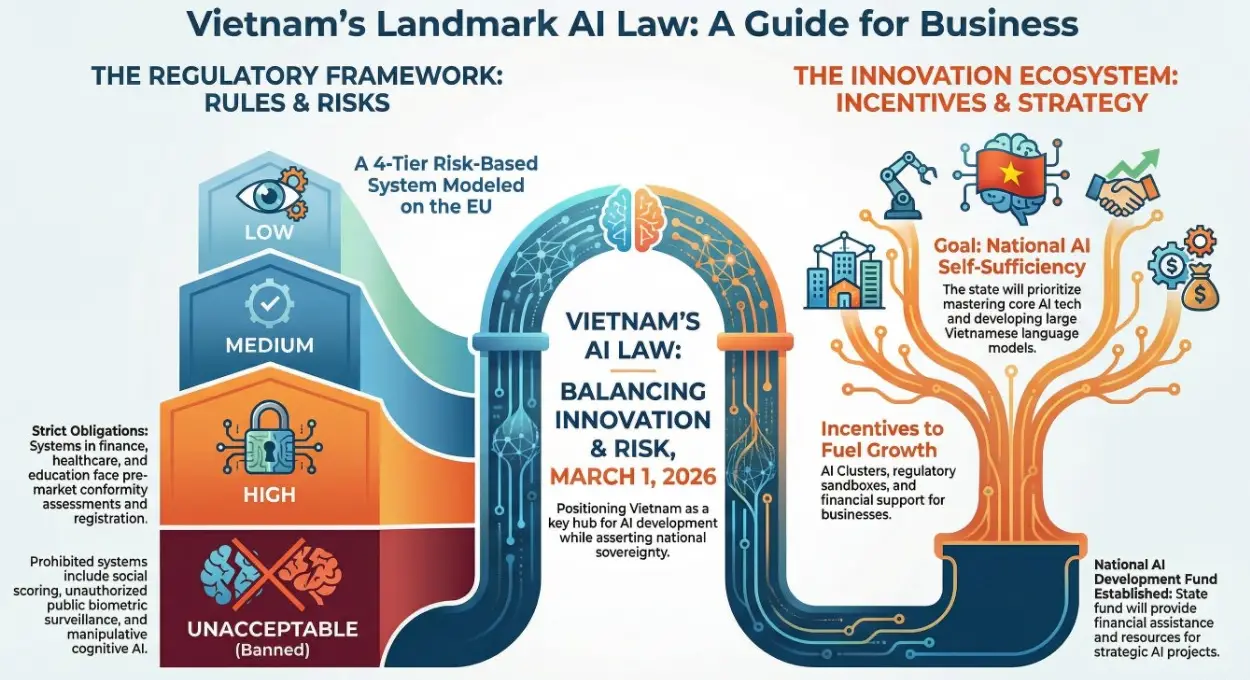
Download: vietnamAI vietnamAI.pdf375 KB.a{fill:none;stroke:currentColor;stroke-linecap:round;stroke-linejoin:round;stroke-width:1.5px;}download-circle For a Vietnamese AI startup, this means launching their product first and dealing with rigorous oversight later, a stark contrast to an EU counterpart who must endure a lengthy and expensive approval process before even entering the market. This choice, along with a slightly altered risk categorization (Unacceptable, High, Medium, and Low), signals a strategic “general openness and flexibility for domestic AI innovation.” Vietnam is deliberately lowering the initial barrier to entry, enabling faster development cycles for its domestic tech sector.
This innovation-first stance is reinforced by a shrewd maneuver on data access. The law’s permissive stance on using copyrighted material for AI training—which only requires respecting an owner’s right to opt-out—is a competitive advantage. It directly subsidizes the creation of “made-in-Vietnam” foundational models, giving local players access to vast datasets that would be legally contentious or prohibitively expensive in the EU.
2. The State as AI Architect: A Push for Digital Sovereignty
Unlike the EU’s focus on market harmonization, Vietnam’s law positions the state as the primary architect and driver of the national AI ecosystem. The goal is not just economic growth, but achieving technological sovereignty. This level of direct state intervention stands in sharp contrast to the US’s market-led model and is more aligned with, yet distinct from, China’s state-centric approach.
This vision is not merely aspirational; it is codified through a comprehensive, three-pronged industrial policy:
- Capital: The establishment of a non-budgetary National AI Development Fund to provide financial assistance for strategic projects.- Tools: The development of a National AI Infrastructure, including state-funded supercomputing resources and shared datasets to support domestic companies.- Control: The creation of a National AI Database to register and monitor all high-risk AI systems, giving the government direct oversight.
Together, these initiatives form a coherent, top-down strategy to build a sovereign AI ecosystem from the ground up. The government’s view on the strategic importance of this technology was bluntly articulated by Minister of Science and Technology Nguyễn Mạnh Hùng, who described AI’s potential as being:
“mightier than nuclear power”
3. Turning Code into Capital: A New Way to Fund the Future
Perhaps the law’s most revolutionary provision is a pioneering move to redefine business capital. The framework formally “recognizes AI models, algorithms, and data assets as lawful capital contributions.”
This is a profound and forward-thinking policy for a developing economy. It allows tech founders to collateralize their primary asset—intellectual property—directly, bypassing potential weaknesses in traditional venture capital or banking ecosystems. This means a company can be legally founded not just on cash in the bank, but on the certified value of its proprietary algorithm, fundamentally changing the startup financing equation. It is a direct attempt to formalize the intangible economy in a way few other nations have, potentially accelerating investment in the local startup ecosystem.
4. From Ethical Vacuum to National Framework: A Race to Catch Up
Just a few years ago, AI ethics were almost entirely absent from Vietnam’s national strategy. A 2021 analysis from the Montreal AI Ethics Institute noted this gap, highlighting ethical blind spots like the celebrated “rice ATMs” during the COVID-19 pandemic, which used facial recognition to monitor recipients of free rice.
The new law marks a dramatic shift, establishing a National AI Ethics Framework and embedding principles like fairness and transparency directly into the legal text. This is more than just good governance; it is a prerequisite for global legitimacy. Without a credible ethical framework, “made-in-Vietnam” AI products would face significant barriers to entry in discerning markets like the EU, making this a crucial move for Vietnam’s export ambitions. This addresses a foundational gap in technical education, as previously noted by Khoat Than, a professor at Hanoi University of Science & Technology:
“AI ethics at the college level is lacking for engineering students. What students learn at universities are still ethics in computer science.”
While this represents a massive leap forward, it also underscores how quickly Vietnam is racing to build the institutional foundations for responsible AI after a period of rapid, largely ethics-agnostic development.
Conclusion: A New Blueprint?
Vietnam’s new AI law makes one thing clear: it is not a passive rule-taker. It is strategically engineering a unique governance model that blends state control, aggressive innovation incentives, and a tailored, risk-based system designed for speed and sovereignty. This playbook is a high-risk, high-reward strategy. If it can manage the inherent dangers of its light-touch approach, it may well create a blueprint for developmental states aiming to leapfrog competitors. If not, it risks becoming a cautionary tale of innovation outpacing governance.
This uniquely Vietnamese model leaves us with a final, thought-provoking question: Will this state-led, innovation-first approach to AI governance become a new model for other ambitious developing nations in the digital age?