
In the evolving landscape of data protection, understanding how consent is obtained and managed across different jurisdictions is crucial for any organization handling personal information. Two of the most prominent regulatory frameworks—those of the European Union (EU) and the United States (US)—approach consent in fundamentally different ways. These distinctions have significant implications for compliance, user experience, and risk management.
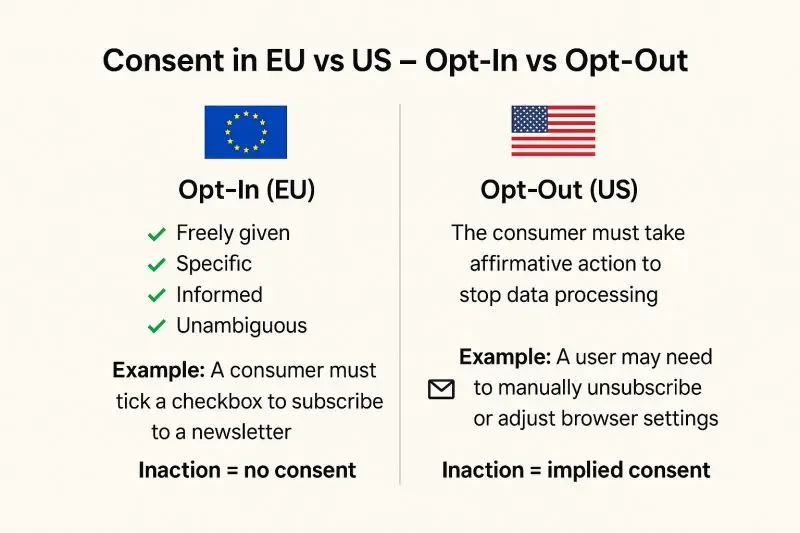
The EU Model: Opt-In Consent
Under the EU’s General Data Protection Regulation (GDPR), consent must meet stringent criteria to be considered valid. It must be:
✅ Freely given ✅ Specific ✅ Informed ✅ Unambiguous
This means individuals must take clear, affirmative action to agree to data processing. For example, a user must actively tick a checkbox to subscribe to a newsletter or accept cookies. Pre-checked boxes, silence, or inactivity do not constitute consent.
Key Principle: Inaction = No Consent
Organizations operating in or targeting users within the EU must implement systems that ensure consent is obtained before any personal data is processed, particularly for marketing or tracking purposes. This opt-in model prioritizes user control and transparency, aligning with GDPR’s emphasis on data subject rights.
The US Model: Opt-Out Consent
By contrast, the US regulatory framework—though evolving with state laws like the California Consumer Privacy Act (CCPA) and Virginia’s Consumer Data Protection Act (VCDPA)—tends to operate under an opt-out model.
In-Depth Analysis of the Virginia Consumer Data Protection Act (VCDPA)
In this model, consent is presumed, and it is the user’s responsibility to take affirmative action to stop or restrict data processing. This could include:
📧 Manually unsubscribing from email lists 🔧 Adjusting browser settings or cookie preferences 🛑 Using “Do Not Sell My Information” links
Key Principle: Inaction = Implied Consent
This approach has traditionally favored business flexibility over consumer privacy, though this is beginning to shift as more states adopt stricter data laws and the US edges closer to federal privacy regulation.
California Consumer Privacy Act (CCPA)
Key Differences and Compliance Considerations
Feature EU (Opt-In) US (Opt-Out)
Default No processing until consent Processing allowed until user opts out
User Action Required before processing Required to stop processing
Regulatory Driver GDPR CCPA, VCDPA, etc.
Risk of Non-Compliance High (fines up to €20M or 4% global turnover) Varies by state, generally lower but increasing
GDPR Compliance Guide: Updated for 2025
Best Practices for Global Compliance
To maintain compliance across borders:
- Implement granular consent mechanisms: Allow users to selectively opt in to different data uses (e.g., marketing, analytics).2. Maintain clear and accessible privacy policies: Transparency is a cornerstone of both models.3. Use geolocation-based consent banners: Tailor opt-in or opt-out flows based on the user’s location.4. Regularly audit consent logs: Be able to prove when and how consent was obtained.5. Stay updated on emerging US laws: States like Colorado and Connecticut are introducing more GDPR-like frameworks.
Conclusion
Consent is not just a legal checkbox—it’s a reflection of user trust and organizational responsibility. While the EU’s opt-in model demands proactive engagement from users before processing their data, the US opt-out model places more burden on individuals to protect their privacy. As global privacy standards converge, adopting opt-in best practices universally can future-proof your organization and demonstrate a commitment to ethical data use.