
The Virginia Consumer Data Protection Act (VCDPA), which took effect on January 1, 2023, represents a significant step in the evolution of data privacy legislation in the United States. As the second state to enact a comprehensive privacy law following California, Virginia’s VCDPA sets a precedent with its unique approach to consumer data protection. This article explores the key components of the VCDPA, its implications for businesses, and the rights it grants to Virginia residents.
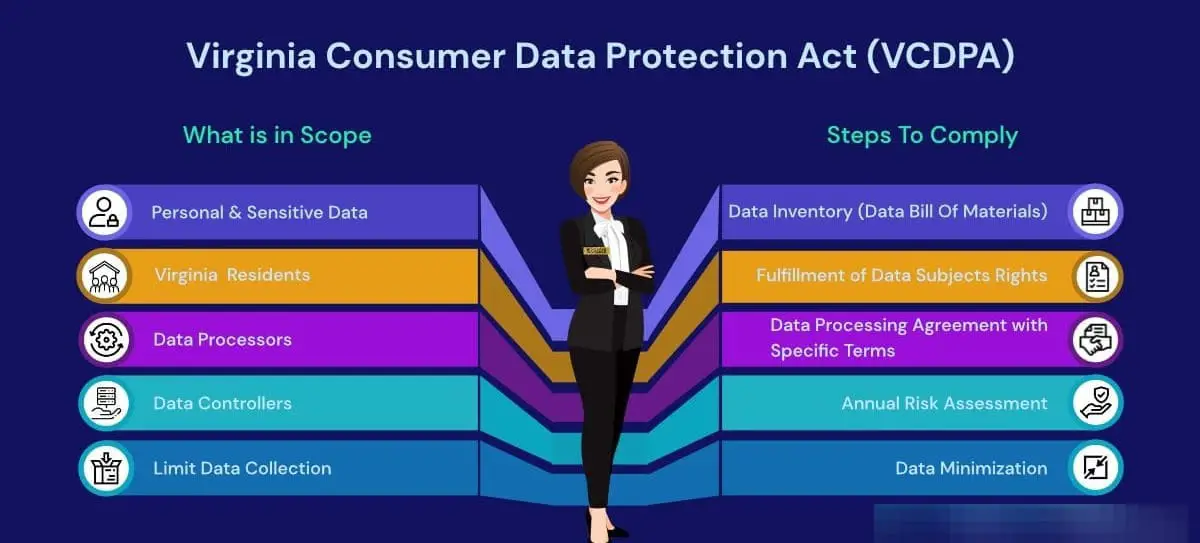
Scope and Applicability
The VCDPA applies to entities conducting business in Virginia or producing products or services targeted to Virginia residents. To fall under the VCDPA’s jurisdiction, a business must meet one of the following criteria:
- Volume of Data Processing: Control or process the personal data of at least 100,000 consumers in a calendar year.- Revenue from Data Sales: Control or process the personal data of at least 25,000 consumers and derive over 50% of gross revenue from the sale of personal data.
This approach ensures that the law targets businesses with significant data processing activities, while smaller entities with limited data interactions are generally exempt.
Consumer Rights
The VCDPA grants Virginia residents several rights concerning their personal data, including:
- Right to Access: Consumers can confirm whether a business is processing their personal data and access that data.- Right to Correction: Consumers can request corrections to inaccuracies in their personal data.- Right to Deletion: Consumers can request the deletion of their personal data.- Right to Data Portability: Consumers can obtain a copy of their personal data in a portable format.- Right to Opt-Out: Consumers can opt out of the processing of personal data for targeted advertising, the sale of personal data, and profiling in furtherance of decisions that produce legal or similarly significant effects concerning the consumer.
These rights empower consumers to exercise greater control over their personal information and require businesses to respond to consumer requests within 45 days, with a possible extension of an additional 45 days if necessary.
Business Obligations
Under the VCDPA, businesses must adhere to several obligations:
- Data Minimization: Limit data collection to what is adequate, relevant, and reasonably necessary for the disclosed purposes.- Consent for Sensitive Data: Obtain consumer consent before processing sensitive data, which includes information revealing racial or ethnic origin, religious beliefs, health, sexual orientation, citizenship or immigration status, genetic or biometric data, and precise geolocation data.- Privacy Notices: Provide clear and comprehensive privacy notices detailing data processing activities and purposes.- Data Protection Assessments: Conduct assessments for processing activities that present a heightened risk of harm to consumers, such as targeted advertising and profiling.- Security Measures: Implement reasonable security practices to protect consumer data.- Non-Discrimination: Ensure consumers are not discriminated against for exercising their rights.
Enforcement and Penalties
The Virginia Attorney General is responsible for enforcing the VCDPA. The law allows for a 30-day cure period for businesses to address violations before enforcement actions are taken. Non-compliance can result in civil penalties of up to $7,500 per violation. Unlike California’s privacy laws, the VCDPA does not provide a private right of action, meaning enforcement is solely through the Attorney General’s office.
Comparison with Other State Laws
While the VCDPA shares similarities with other state privacy laws, such as the California Consumer Privacy Act (CCPA), it has distinct differences, particularly in its enforcement mechanisms and lack of a revenue threshold for applicability. The VCDPA’s focus on data processing volume and revenue from data sales reflects a targeted approach to regulating businesses with significant data interactions.
Conclusion
The Virginia Consumer Data Protection Act sets a high standard for data privacy protection, emphasizing consumer rights and business accountability. As businesses continue to adapt to the VCDPA’s requirements, they must conduct thorough data audits, update privacy policies, and implement robust data protection measures. The VCDPA not only aligns with other state privacy laws but also introduces unique provisions that enhance consumer control over personal data. As the regulatory landscape continues to evolve, the VCDPA serves as a critical model for balancing innovation with privacy protection.
Citations: [1] https://www.termsfeed.com/blog/colorado-cpa/ [2] https://www.upguard.com/blog/vcdpa [3] https://www.redgravellp.com/devil-details-key-differences-us-data-privacy-laws [4] https://usercentrics.com/knowledge-hub/virginia-consumer-data-protection-act-vcdpa/ [5] https://pro.bloomberglaw.com/insights/privacy/the-vcdpa-vs-ccpa-comparing-state-privacy-laws/ [6] https://www.hutchlaw.com/blog/an-overview-of-the-virginia-consumer-data-protection-act [7] https://www.whitefordlaw.com/news-events/client-alert-virginia-privacy-law-takes-effect-january-1-2023 [8] https://pro.bloomberglaw.com/insights/privacy/virginia-consumer-data-protection-act-vcdpa/